
These "Big 4" metros dictate the rhythm of urban growth in India
The Indian real estate market is accelerating toward a monumental $500 billion valuation, with institutional capital and residential sales overwhelmingly concentrated in just four cities: the Mumbai Metropolitan Region (MMR), Delhi-NCR, Bengaluru, and Hyderabad. Together, these "Big 4" metros dictate the rhythm of urban growth in India, serving as the primary magnets for High-Net-Worth Individuals (HNIs), non-resident investors, and corporate capital. Yet, viewing these four giants through a single investment lens is one of the costliest mistakes an investor can make.
Consider a standard capital allocation of ₹2 Crore. Placed in Mumbai’s sea-locked, ultra-luxury enclave of Worli, that capital functions as a fortress of capital preservation yielding a modest 1.8% to 2.5% in rental income while shielding wealth against market volatility. Take that exact same sum to Bengaluru’s booming tech corridors like Whitefield or Bellandur, and it instantly transforms into a high-cash-flow asset generating 4.5% or more in annual rental yields driven by an endless stream of IT professionals and GCC leadership. Meanwhile, shifting south to Hyderabad’s liberal-FSI mega-townships in Kokapet or north to Delhi-NCR’s infrastructure-led corridors along the Dwarka Expressway unlocks vastly different capital appreciation cycles.
The takeaway for savvy home buyers and investors is clear: successful real estate allocation in India isn’t about chasing a generic "best city." It is about aligning your specific financial goals—whether cash flow generation, aggressive capital appreciation, or generational wealth protection—with the distinct structural reality of the right metropolitan market. Here is how India's Big 4 stack up side-by-side.
City-by-City Investment Breakdown
Mumbai Real Estate Investment: Capital Preservation (MMR)
Mumbai is not an aggressive rental yield play—it is India’s premier financial vault. Sea-locked geography and strict zoning mean land supply is inherently inelastic, driving sustained long-term capital preservation even during broader economic downturns.
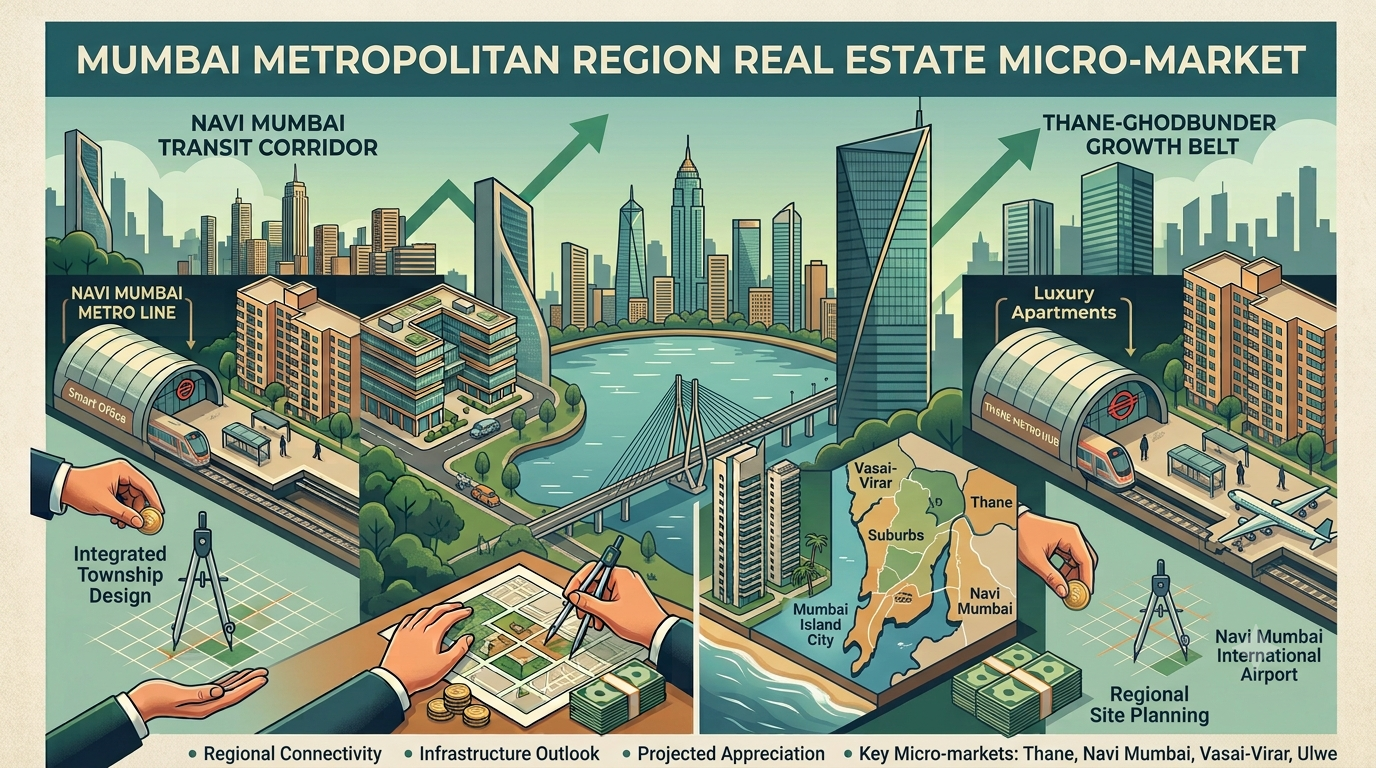
The Investor Dynamic: Low rental yields paired with high, non-negotiable entry barriers. Capital appreciation is steady and defensive rather than explosive.
Top Micro-Markets:
Ultra-Prime / Heritage: Worli, Bandra West, Lower Parel (₹45,000 to ₹1,20,000+ / sq. ft.).
Appreciation Corridors: Thane West, Navi Mumbai, and the Atal Setu (MTHL) landing zones.
Redevelopment Engine: With vacant land virtually non-existent in core Mumbai, society redevelopment under slum rehabilitation and cluster schemes drives new supply, often yielding substantial floor-area upgrades for early investors.
Delhi-NCR Property Investment: High Capital Growth Potential
Delhi-NCR’s real estate ecosystem spans multiple municipal jurisdictions (Gurugram, Noida, Greater Noida, and Delhi proper), making it a high-volume, high-ticket capital growth market. Fueled by massive infrastructure projects, NCR has become the top destination for ultra-luxury residential bets.

The Investor Dynamic: Moderate yields backed by powerful capital growth cycles. End-users favor sprawling floor plates (3,000+ sq. ft. 4BHKs and penthouses), while luxury builder floors remain South Delhi’s dominant asset class.
Top Micro-Markets:
Gurugram Power Belts: Golf Course Road, Golf Course Extension, Dwarka Expressway (₹14,000 to ₹40,000+ / sq. ft.).
Infrastructure-Led Growth: Sector 150 & Expressway belts in Noida (benefiting from Yamuna Expressway & Noida International Airport connectivity).
Execution Risk: Supply in outer NCR belts can adjust rapidly; investors must prioritize top-tier private developers with proven delivery track records to avoid long construction delays.
Bangalore Real Estate: High Rental Yield & End-User Demand in Karnataka
Bengaluru’s property market, located in Karnataka, is heavily backed by real end-user demand. Supported by IT executives, startup founders, and expanding Global Capability Centers (GCCs), the city offers strong cash-flow fundamentals and minimal speculative volatility.

The Investor Dynamic: Leads Tier-1 India in residential rental yields (3.5%–4.5%). High tenant turnover around technology hubs translates into low vacancy rates and strong, predictable monthly rental cash flow.
Top Micro-Markets:
Core Tech Corridors: Sarjapur Road, Outer Ring Road (ORR) (₹10,000 to ₹18,000 / sq. ft.).
Capital Growth Frontier: North Bengaluru (Devanahalli, Yelahanka, Thanisandra) driven by proximity to Kempegowda International Airport.
Infrastructure Factor: Micro-market appreciation is tied closely to Namma Metro phase completions and water-security planning. For more information on city infrastructure, visit the Bengaluru government portal.
Hyderabad Property Investment: Infrastructure & Large-Scale Developments
Hyderabad stands out due to state policies like liberal Floor Space Index (FSI) limits, enabling developers to build sprawling, high-density mega-townships with world-class amenities.

The Investor Dynamic: Offers massive unit sizes at lower per-square-foot entry rates compared to Mumbai or Delhi. The market has experienced strong appreciation driven by aggressive commercial IT expansion in its western corridor.
Top Micro-Markets:
Western Luxury Belt: Kokapet, Financial District, Narsingi, Tellapur (₹11,000 to ₹18,000+ / sq. ft.).
Established Prestige: Jubilee Hills, Banjara Hills.
Supply Consideration: Liberal building norms mean substantial supply pipeline additions. Capital growth relies on holding assets through 5- to 7-year cycles until surrounding commercial corridors fully mature.
Which "Big 4" city aligns best with your portfolio goals? Are you chasing high rental cash flow in Bengaluru, or locking in capital preservation in Mumbai? Drop a comment below with your target investment corridor or the market question holding you back.
Written By : Nihal kashyap
Lavish Living Homes: Curating exceptional residences where strategic real estate investment meets the art of uncompromised luxury.
Looking for a luxury home in Bengaluru?
Our advisors curate options that match your brief — privately.
Talk to an advisor