
NRI Guide: Buying a Villa in Bangalore, Karnataka - Lavish Living
For many Non-Resident Indians (NRIs), owning a villa back home isn't just an investment; it's a plan for retirement, a base for visits, or simply a way to stay rooted. Bangalore, often called the Silicon Valley of India, with its thriving IT-driven economy, pleasant climate, and fast-growing villa communities, has become one of the top choices for NRIs looking to buy independent homes in Karnataka.
However, purchasing property in Bangalore from thousands of miles away comes with its own set of unique questions. What can you legally buy as an NRI? How do you fund such a significant purchase? What taxes apply to your investment?
This comprehensive guide will walk you through the entire process of buying a villa in Bangalore, step by step, providing clarity on legalities, funding, and essential checks for a smooth transaction.
1. Can Non-Resident Indians Buy a Villa in Bangalore?
Yes. Under general permission granted by the Reserve Bank of India (RBI), NRIs and OCI (Overseas Citizen of India) cardholders can freely purchase residential property — including villas — anywhere in India, Bangalore included. There's no cap on the number of residential properties you can own, and you don't need special RBI approval or to file any intimation with the central bank for a standard purchase.
The only properties off-limits to NRIs are agricultural land, farmhouses, and plantation property; these require special government or RBI approval. Since a villa is classified as residential property, it falls squarely within what NRIs can buy without restriction.
One exception to keep in mind: citizens of Pakistan, Bangladesh, Sri Lanka, Afghanistan, China, Iran, Nepal, and Bhutan need prior RBI approval regardless of residency status. This doesn't apply to OCI cardholders, who fall under the normal NRI rules.
2. Why Invest in a Luxury Villa in Bangalore as an NRI?
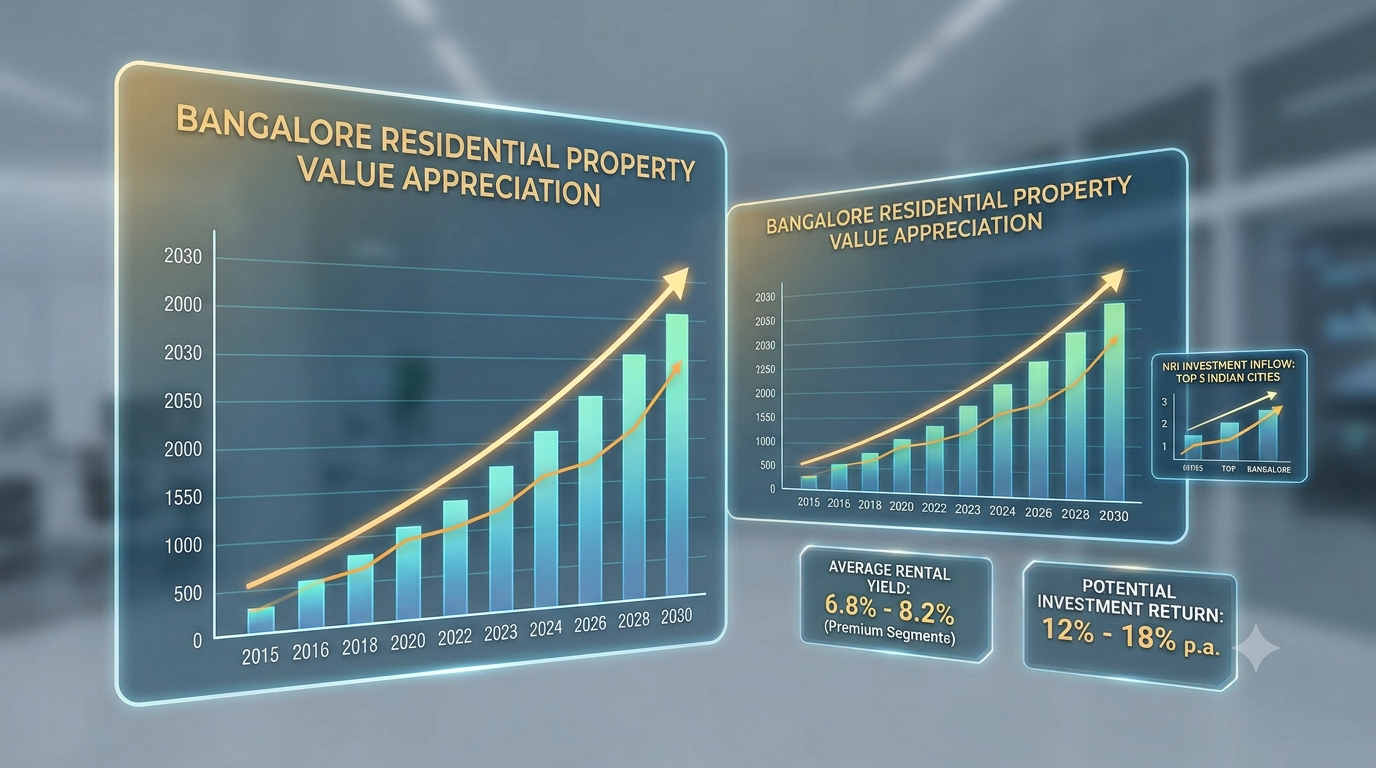
Rental demand from the IT workforce — Bangalore's tech corridors (including Whitefield, home to Riviera Uno by Goyal & Co., Sarjapur Road, and Electronic City) keep rental demand strong, useful if you're not moving in immediately.
Gated villa communities — Gated villa communities like NVT Oikos in Whitefield offer security, clubhouse amenities, and maintenance services, which matter when the owner isn't around to manage the property personally.
Appreciation potential — Infrastructure projects like the Peripheral Ring Road and metro extensions are opening up newer villa corridors in areas such as Devanahalli and North Bangalore with projects like Riviera Glade by Goyal & Co. Hariyana Group, offering significant room for price growth. For those eyeing luxury villas in North Bangalore like The Midsummer Rain by Capstone Life, these developments enhance long-term investment value.
Retirement and return planning — A villa offers more space and privacy than an apartment, which appeals to NRIs planning an eventual move back to Karnataka. If you are exploring unique villa options in rapidly developing localities like Budigere Cross, projects such as NVT Under The Open Sky Villa offer exceptional living spaces. Similarly, exclusive residences like Chaithanya Sankhya Sky Bunglows provide distinct luxury experiences in emerging areas of Bangalore.
3. NRI Home Loan & Funding Options for Villas in Bangalore
You cannot simply wire money from a regular foreign bank account. Under FEMA regulations, NRIs must route property payments through specific Indian bank accounts:
NRE (Non-Resident External) Account — Holds foreign earnings converted to INR; funds (including principal) are freely repatriable.
NRO (Non-Resident Ordinary) Account — Holds income earned in India (rent, dividends); repatriation is capped and taxed.
FCNR Account — Holds foreign currency deposits, less commonly used for direct property payment.
Payments must be made in Indian Rupees; you cannot pay in foreign currency or through traveller's cheques. Cash payments are not permitted either.
Home loans: Indian banks and NBFCs registered with the National Housing Bank are permitted to lend to NRIs for residential purchases in Bangalore. The loan must be repaid in Indian Rupees, typically through NRE/NRO accounts or remittances, and lenders usually require a Power of Attorney (PoA) if you can't be physically present for processing.
4. Power of Attorney (PoA) for NRI Property Purchase in Karnataka
Since most NRIs can't be in Bangalore for every step of a purchase, a registered PoA lets a trusted person — a relative, friend, or lawyer — sign documents, register the sale deed, and handle possession on your behalf. Key points:
The PoA should be specific about what the holder can and cannot do (avoid overly broad, unlimited powers).
If executed outside India, it typically needs to be notarized and attested by the Indian consulate/embassy, then stamped in India within the prescribed period in Karnataka.
Choose someone genuinely trustworthy; a PoA holder has real authority over your transaction.
5. Essential Legal & Documentation Checklist for NRI Villa Buyers in Bangalore
Before signing anything for your villa purchase in Bangalore, verify:
RERA registration — Confirm the project is registered with Karnataka RERA (K-RERA); this protects against delays and misrepresentation.
Title deed and chain of ownership — Ensure clear, marketable title with no disputes.
Encumbrance Certificate (EC) — Confirms the property is free of loans or legal claims.
Khata certificate — Required for property tax and utility connections in Bangalore; check whether it's an A-Khata (fully compliant) or B-Khata (irregular, harder to resell or mortgage).
Approved building plan and layout — Sanctioned by BBMP/BDA or the relevant local authority.
NOCs — From the relevant authorities (fire safety, pollution control, etc., where applicable).
Sale agreement and sale deed — Reviewed carefully, ideally by a property lawyer familiar with NRI transactions.
Given the distance, it's worth engaging a local lawyer to independently verify documents rather than relying solely on the builder's or seller's paperwork.
6. Understanding Taxes on NRI Villa Purchases in Bangalore
Here are the key taxes NRIs should be aware of when buying a villa in Bangalore:
Stamp duty and registration charges — Same rates as apply to resident Indian buyers in Karnataka, based on property value.
TDS on resale purchases — If buying a resale villa (not directly from a builder) worth over ₹50 lakh, you must deduct TDS before paying the seller, at rates that differ depending on whether the seller is a resident or an NRI.
TDS when selling later — If you eventually sell, TDS applies on capital gains, generally higher for short-term gains than long-term.
Capital gains tax — Long-term (property held over 2 years) and short-term rates differ; certain exemptions (like reinvesting in another property) can reduce liability.
Repatriation of sale proceeds — Proceeds can generally be repatriated up to USD 1 million per financial year, subject to conditions and proper documentation (including a CA certificate).
Because these rules and thresholds are revised periodically, confirm current rates with a chartered accountant experienced in NRI taxation before you transact.
7. Critical Documents to Verify Before Buying an NRI Villa in Bangalore
This is the step NRI buyers most often shortcut — because they can't walk into the sales office or the sub-registrar's office themselves. That's exactly why it deserves extra rigor. Before you pay a booking amount or sign anything, ask the builder to share the following, and don't proceed until you (or your lawyer) have actually seen and verified them — not just been told they exist.
A. Title and Land Documents for Your Bangalore Villa
Title deed / mother deed — Traces ownership of the land back through previous owners. Confirms the builder actually owns (or has clear development rights to) the land, with no gaps in the chain of ownership.
Encumbrance Certificate (EC), ideally covering 15–30 years — Confirms the land is free of loans, mortgages, or legal claims.
Conversion certificate — If the land was originally agricultural, proof it has been legally converted to non-agricultural (residential) use. Villas built on unconverted land are a serious red flag.
Joint Development Agreement (JDA), if applicable — If the builder developed the project with the original landowner, this defines who has rights to sell what.
B. RERA & Regulatory Approvals for Villas in Karnataka
RERA registration certificate — Every project should carry a Karnataka RERA (K-RERA) number. Ask for the number and verify it yourself on the official K-RERA portal rather than taking a screenshot from the builder at face value.
Approved building plan / layout plan sanctioned by BBMP, BDA, or the relevant local planning authority — And check that what's being built on-site actually matches the approved plan.
Commencement Certificate (CC) — Confirms construction was legally authorized to begin.
Occupancy Certificate (OC) — For ready or nearly-ready villas, this certifies the structure is complete and fit for occupation. Never take possession, and never pay the final installment, without a copy of the OC (or a firm, penalty-backed commitment for when it will be issued).
NOCs from relevant departments — Fire safety, pollution control, airport authority (if near flight paths), and tree/environmental clearance where applicable.
C. Project & Financial Documents: What NRIs Need to Check
RERA-registered sale agreement — Must clearly state the possession date, payment schedule, carpet/built-up area, specifications, amenities promised, and penalty clauses for delay.
Escrow account details — Under RERA, builders must deposit 70% of buyer payments into a separate project-specific escrow account. Ask which account and, if possible, verify it's the one declared on the RERA portal.
Cost sheet / price breakup — A clear, itemized breakdown of base price, floor rise, car parking, club membership, GST, and any other charges — not just one lump "all-inclusive" figure.
Payment schedule tied to construction milestones (for under-construction projects), not an arbitrary time-based schedule.
D. Researching Your Villa Developer's Track Record in Bangalore
Past project delivery history — Ask for a list of completed projects with actual possession dates versus what was originally promised.
RERA complaint history — Searchable on the K-RERA portal against the builder's or project's registration number.
Litigation check — Ask directly whether the builder or the specific project has any ongoing legal disputes, and independently check court records where feasible.
E. Key Questions to Ask Your Builder Before Buying a Villa in Bangalore
What is the exact RERA registration number for this specific project (not just the builder's group)?
Can you share the approved layout and sanctioned plan directly, rather than a marketing brochure?
What is the current construction status, and can you share recent site photos or a video walkthrough, given I can't visit in person?
What happens if possession is delayed — is there a penalty clause in the agreement, and how has it been honored on past projects?
Is the Khata an A-Khata or B-Khata, and is it already transferred/transferable in the buyer's name?
Who bears the cost and process for registering a Power of Attorney if I can't be present for registration?
What after-sales support or property management services do you offer for owners who won't be resident in India — maintenance, rental assistance, key-holding?
Are there any pending dues, mortgages, or bank charges on this specific unit or the underlying land?
If a builder is reluctant to share any of the above, hedges with vague answers, or insists everything is "in process," treat it as a red flag. A credible developer should have no difficulty producing these documents on request. Given the distance involved, it's worth paying a local property lawyer a fixed fee purely to verify this documentation independently before you transfer any money.
8. Practical Tips for a Smooth NRI Villa Purchase in Bangalore
Visit if you can. Even one trip to inspect the property, meet the builder, and verify the neighborhood in person is worth it before a decision of this size.
Verify the builder's track record. Check past project delivery timelines, RERA complaint history, and talk to existing residents if possible.
Get an independent legal opinion. Don't rely only on the developer's documentation — pay for an independent title search.
Plan for property management. If you won't live there right away, decide upfront how you'll handle maintenance, rental management, and property tax payments — many gated communities offer this as a service, or you can explore local property management services.
Keep repatriation in mind from day one. If you might sell or move funds back abroad later, ensure your purchase is funded and documented in a way that keeps repatriation straightforward.
Budget for total cost, not just the sale price. Stamp duty, registration, GST (on under-construction property), legal fees, and PoA costs can add 8–12% on top of the property price.
9. Making an Informed NRI Villa Investment in Bangalore
Buying a villa in Bangalore as an NRI is entirely feasible and, for many, a rewarding long-term investment. However, it works best when treated as a structured process rather than a one-time transaction. Get your funding channel right, verify documents independently, use a trustworthy PoA if needed, and involve professionals — a local lawyer and a CA familiar with NRI rules — early rather than after money has changed hands.
With the right groundwork, a Bangalore villa can be both a solid investment and a home waiting for you whenever you're ready to return to Karnataka.
Written by: Rishikesh For further information, contact: 6366823623
Looking for a luxury home in Bengaluru?
Our advisors curate options that match your brief — privately.
Talk to an advisor